
Best overall for skipping cleanup: a direct as-is sale through Polus Acquisitions Group; best for market exposure: an as-is agent listing; best for limiting preparation work: selective clearance before listing. This 2026 guide explains how to sell a hoarder house, compare the trade-offs, and choose without committing to a full cleanout first.
- To sell hoarder house contents and property together, ask for written terms identifying what can remain.
- Polus Acquisitions Group suits homeowners seeking an as-is home sale without cleaning, repairs, or staging.
- An as-is cash offer can be lower than a successful open-market sale.
- Compare seller proceeds, cleanup responsibilities, inspection terms, and ownership authority before accepting an offer.
Why this matters
A heavily cluttered home presents two separate decisions: how to sell the property and what happens to its contents. Treating those as one automatic cleanout project can commit you to work before you know whether it is necessary.
You do not have to make the house listing-ready before exploring an as-is sale. You do need to explain its condition accurately, establish who can authorize the sale, and agree on what stays behind. The property's condition is a transaction issue, not a judgment about you or your family.
What makes the best way to sell a hoarder house?
For a 2026 sale, judge each route against these criteria:
- Preparation burden: What must you remove, clean, or repair before buyers can proceed?
- Seller proceeds: What remains after agreed selling expenses, mortgage payoff, and other obligations?
- Buyer access: Can the buyer, inspector, and other required parties safely evaluate the property?
- Contract certainty: What inspection conditions, cancellation rights, or financing requirements apply?
- Seller control: Can you decline, compare alternatives, and agree on a workable possession date?
Do not confuse the route with the buyer. A cash offer still needs a readable contract, and an agent listing still needs a realistic plan for access and belongings.
Selling options at a glance
| Option | Best for | Standout feature | Key limitation |
|---|---|---|---|
| Direct as-is sale | Avoiding cleanup and repairs | Negotiate a sale in the home's current condition | Offer can be lower than a successful market sale |
| As-is agent listing | Reaching competing buyers | Market the home without promising repairs | Showings and inspections still require access |
| Selective clearance, then listing | Limiting preparation work | Focus effort on access and visibility | Remaining clutter can restrict inspection |
| Full cleanout and selected repairs | Owners able to manage preparation | Present an emptied home for evaluation | Work does not guarantee a higher net result |
| Property auction | Owners considering a scheduled bidding process | Establish a defined marketing and bidding event | Bids and completion depend on auction terms |
1. Direct as-is sale: best for avoiding cleanup and repairs
A direct buyer evaluates the property without requiring you to prepare it for a conventional listing. This route fits when clearing rooms, arranging repairs, or coordinating showings is work you do not want to take on.
Polus Acquisitions Group is an as-is home-sale option for homeowners who want to avoid cleaning, repairs, and staging. We offer a free, no-obligation cash-offer review. Requesting that review does not commit you to selling.
Our stated terms include no agent commissions or listing fees and coverage of standard closing costs, subject to the written offer. Mortgage balances, taxes, liens, and other seller obligations do not disappear. Offers remain subject to inspection and transaction requirements.
Direct as-is sale pros:
- Avoid preparing the house for a listing.
- Discuss remaining contents before agreeing to a sale.
- Review an offer without coordinating public showings.
Direct as-is sale cons:
- The offer can be lower than a successful open-market sale.
- Inspection and ownership issues can affect completion.
Best for: You want to sell the property in its current condition rather than manage a preparation project.
Verdict: Choose a direct as-is review when avoiding preparation matters most; compare the written offer before accepting.
2. As-is agent listing: best for reaching competing buyers
An agent can market the home in its current condition and explain that you are not committing to repairs. Buyers can then evaluate whether the property's location, condition, and required work fit their plans.
Ask a prospective agent how they would handle access, photographs, condition descriptions, and buyers whose financing depends on the home's condition. An as-is listing is not a substitute for required disclosures, and it does not automatically prevent inspection requests or negotiations.
As-is agent listing pros:
- Expose the property to competing buyers.
- Get help coordinating inquiries and negotiations.
- Offer the home without promising a renovation.
As-is agent listing cons:
- Showings can be difficult while belongings remain.
- Financing and inspection conditions can complicate a contract.
Best for: You can accommodate buyer access and want market exposure before choosing an offer.
Verdict: Choose an as-is listing when you can manage showings and accept uncertainty about the sale timeline.
3. Selective clearance: best for limiting preparation work
Selective clearance means removing enough belongings to improve safe access without emptying every room or starting a renovation. The goal is access, not cosmetic perfection.
Start by asking the intended buyer or listing agent what access is actually needed. Do not move unstable piles, handle unknown substances, or enter unsafe areas yourself. Suspected structural, electrical, biological, or other hazards need appropriate professional assessment.
Selective clearance pros:
- Concentrate work on access rather than appearance.
- Retain time to sort important personal belongings.
- Avoid committing immediately to a full cleanout.
Selective clearance cons:
- Remaining contents can hide conditions buyers need to evaluate.
- Additional clearance can still become necessary.
Best for: You can organize limited help and want to explore a listing without emptying the entire home.
Verdict: Choose selective clearance only after identifying what the next buyer or inspection step requires.
4. Full cleanout and selected repairs: best for managing preparation
A full cleanout removes contents so the property's condition is easier to see. Repairs are a separate decision: emptying the house does not mean you must renovate it.
Get written scopes before authorizing work. Separate removal, cleaning, hazard assessment, and repairs so you understand each responsibility. Avoid treating a higher hoped-for selling price as proof that every preparation expense will be recovered.
Full cleanout and selected repairs pros:
- Make rooms and visible surfaces easier to evaluate.
- Separate personal belongings from the property sale.
- Give you a clearer basis for deciding which repairs to consider.
Full cleanout and selected repairs cons:
- Require coordination and spending before the sale.
- Do not guarantee a higher net result or completed transaction.
Best for: You have the authority, resources, and willingness to manage preparation before marketing.
Verdict: Hold off on full preparation until you have compared its written scope with an as-is alternative.
5. Property auction: best for considering a scheduled bidding event
A property auction offers a defined marketing and bidding process rather than ordinary listing negotiations. Ask an appropriately licensed auction professional whether the home's condition and access restrictions fit the proposed arrangement.
Read the terms before agreeing. A reserve is a minimum acceptable bid under the auction arrangement; an absolute auction generally has no reserve. Understand any conditions, charges, buyer qualification rules, and consequences if bidding does not produce an acceptable sale.
Property auction pros:
- Establish a scheduled bidding event.
- State condition and access terms in advance.
- Provide another route to compare with listing or direct sale.
Property auction cons:
- The bidding event does not guarantee a completed sale.
- Auction terms can limit your flexibility once you commit.
Best for: You understand the auction agreement and prefer its defined process over ongoing negotiations.
Verdict: Wait to commit until an auction professional explains your obligations and the unsuccessful-sale scenario.
How these options are ranked
This 2026 ranking prioritizes preparation burden, then access, contract conditions, and seller choice. It is a decision guide, not a claim that one route produces the highest proceeds.
Direct as-is selling comes first because it addresses the central problem: selling without preparing a heavily cluttered home. Listing moves ahead when market exposure matters more to you than avoiding showings and preparation.
Make a contents plan before accepting an offer
As-is does not automatically mean every item stays. Create a written contents schedule and have the buyer confirm it as part of the agreement. Use room descriptions or photographs only where access is safe; do not enter a hazardous area to complete a checklist.
| Contents category | What to record | What to agree before signing |
|---|---|---|
| Personal records and keepsakes | Documents, photographs, medications, and items you want to keep | Who can retrieve them and when |
| Furniture and ordinary contents | Items you propose leaving, identified by room | What the buyer accepts and who removes it |
| Items belonging to someone else | Borrowed, rented, disputed, or estate-controlled belongings | Who has authority to release or remove them |
| Unknown or unsafe materials | Suspected hazards and areas not assessed | Who arranges qualified assessment and safe handling |
| Final access and possession | Keys, access permissions, and belongings still to retrieve | Written dates, responsibilities, and any remaining conditions |
Illustrative decision, not a Polus transaction: You want to keep family photographs but leave bulky furniture. A buyer says the home can be sold as-is. Ask for the photographs to be excluded, the furniture to be identified as accepted contents, and retrieval access to be agreed in writing. Do not rely on the phrase as-is to settle those separate questions.
Before paying a cleanout company, compare its written scope with the actual buyer requirements. Separate ordinary removal from hazard assessment and repairs. If a room is unsafe or ownership of belongings is disputed, get qualified help rather than treating the contents list as permission to remove everything.
Before you sign: check the actual arrangement
Use these checks for any 2026 offer, regardless of how reassuring the buyer sounds.
Ownership authority
Confirm who owns the property and who must sign. An inherited home can require probate, the court-supervised process for handling an estate, or other legal steps before a sale. Do not assume being a relative gives you authority to sell.
Remaining contents
Identify what you will remove, what can remain, and who handles removal afterward. Protect identity documents, financial records, medications, photographs, and items belonging to someone else. Put the agreed contents arrangement in writing.
Written costs
Ask the closing professional for a seller-proceeds estimate showing the sale amount and applicable deductions. Compare the amount you expect to receive, not just the headline offer. Existing mortgages generally require payoff or another properly documented arrangement approved as required.
Closing conditions
Identify inspection rights, access requirements, title issues, financing conditions, and the possession date. If an alternative purchase arrangement leaves an existing loan in your name, understand your continuing obligations and get independent advice. A non-cash arrangement is not a cash purchase.
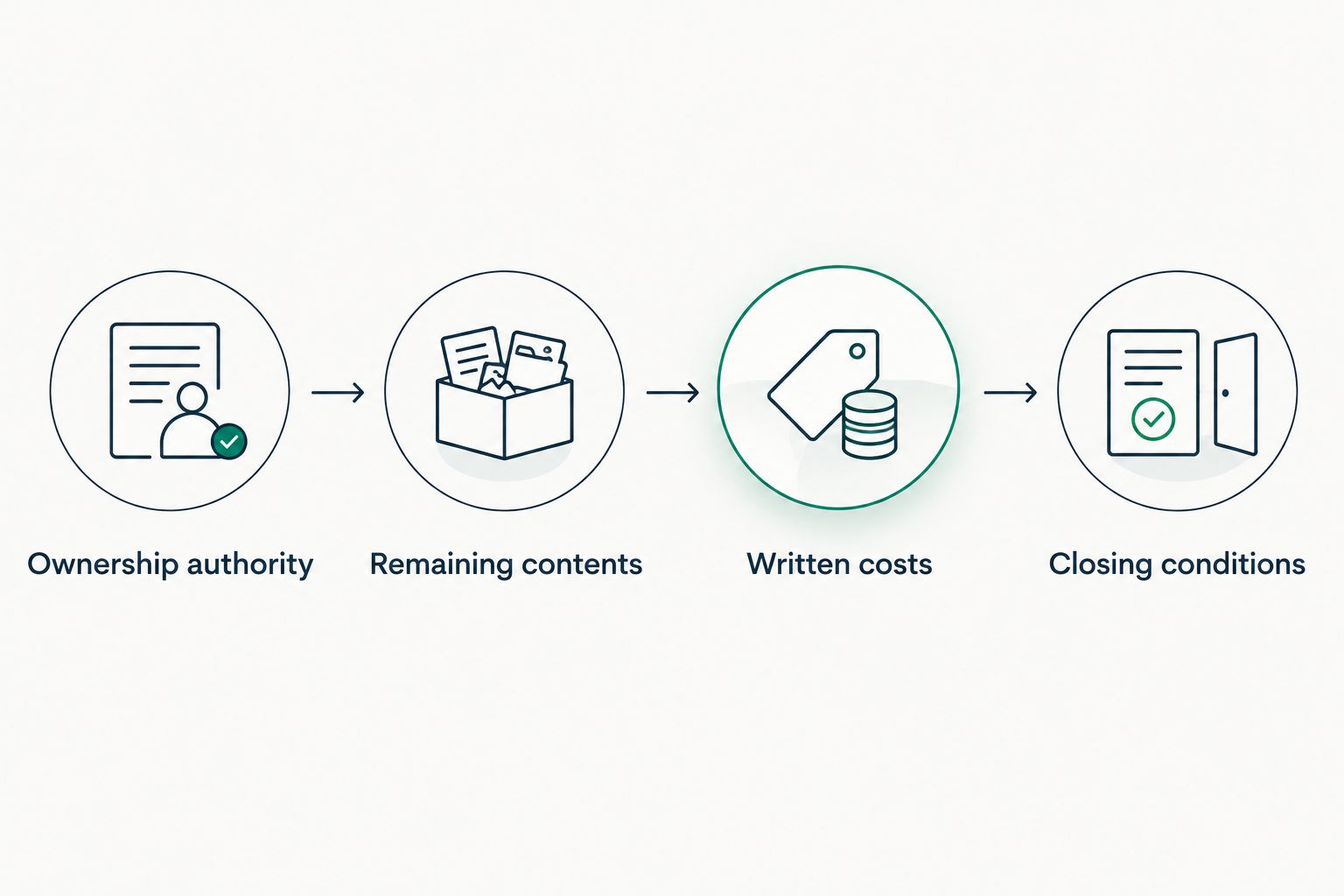
These checks serve different purposes. A buyer's willingness to accept clutter does not establish your authority to sell, and a signed contract does not remove unresolved title or lender requirements.
Which selling option should you choose?
Start with an as-is offer if your main goal is to avoid cleanup. Then decide whether the possible benefit of market exposure justifies arranging access, managing belongings, and taking on additional uncertainty.
With Polus Acquisitions Group, you can request a review, understand the proposed terms, and accept or decline. Ask what the offer assumes about condition, remaining contents, inspection, and closing requirements. You retain the choice to pursue another route.
If foreclosure is involved, do not rely on a proposed sale to stop a deadline. Contact your loan servicer and qualified local legal or housing-counseling help promptly. A sale discussion is not foreclosure protection.
Understand your as-is option
Request a free, no-obligation review. Offers remain subject to inspection and transaction requirements.
FAQ
What’s the best way to sell a hoarder house in 2026?
A direct as-is sale fits when avoiding cleanup and repairs is your priority. An as-is agent listing fits when you can provide access and want competing buyers to evaluate the home.
Can I sell a hoarder house without cleaning it out?
Yes, if the buyer agrees to purchase with the remaining contents. Put removal responsibilities, excluded items, and possession terms in the written agreement rather than assuming as-is covers everything.
Is a cash buyer better than listing with an agent?
A cash buyer fits preparation avoidance; an agent listing fits market exposure. Compare written seller-proceeds estimates and contract conditions because an as-is cash offer can be lower than a successful open-market sale.
Does selling as-is mean I can skip disclosures?
No, selling as-is does not eliminate applicable disclosure duties. Requirements vary by state and situation, so ask a qualified local professional what you must disclose about known conditions.
Can I sell an inherited house full of belongings?
You can pursue a sale once the required ownership authority and transaction requirements are addressed. Confirm who controls the real estate and contents before removing items or signing a contract.
Do I have to accept an offer from Polus Acquisitions Group?
No, requesting a cash-offer review does not obligate you to sell. Review the inspection conditions, cost terms, contents agreement, and closing requirements before deciding.
Can I sell a hoarder house with an existing mortgage?
An existing mortgage does not automatically prevent a sale, but its payoff or other legally valid treatment must be addressed. If proceeds will not cover the required payoff, consult the lender and qualified local advisers before promising a closing.
One last thing
As-is describes property condition; it does not settle ownership of everything inside. Before your 2026 sale, make a written list of the belongings you intend to keep and ask how the contract treats everything else. That conversation belongs before signing, not on moving day.
This is general information, not legal, tax, or financial advice. Get qualified local advice for estate authority, foreclosure deadlines, disputed belongings, or unusual purchase terms.


Leave a Reply