
Best default when you can prepare and market the home: an agent-listed sale. Best for avoiding repairs and listing preparation: a direct as-is cash sale. Best for controlling the sale yourself: a for-sale-by-owner transaction. You can sell a house with an existing mortgage in 2026; the usual route pays off the loan from the sale proceeds at closing.
- Sell house with mortgage: arrange a lender payoff, not just a transfer of ownership.
- Polus Acquisitions Group offers an as-is sale option without preparing your home for a listing.
- Compare what you keep after mortgage payoff, seller costs, and other amounts due.
- A loan assumption requires lender approval; a short sale requires approval of a payoff shortfall.
Why this matters
Selling your home and ending your mortgage obligation are related, but they are not the same thing. A deed transfers ownership. Your lender must receive the required payoff or formally approve another arrangement that addresses your obligation.
Polus Acquisitions Group is an as-is home-sale option for homeowners who want to avoid listing preparation. You can review Polus Acquisitions Group alongside a listed sale rather than assuming either route fits every situation.
The right choice in 2026 depends on your equity, the property's condition, your deadline, and the lender's requirements. Start with those facts, not a promised closing date.
What makes the best way to sell with a mortgage?
Use these criteria before choosing a buyer or signing a listing agreement:
- Mortgage resolution: Does closing pay off the loan, or does the lender approve a different arrangement?
- Net proceeds: What remains after payoff, selling costs, and other obligations?
- Preparation: Will you need repairs, cleaning, staging, or access for showings?
- Closing conditions: What inspections, financing requirements, and title issues remain?
- Control and workload: Who handles marketing, buyer screening, paperwork, and follow-up?
- Continuing liability: Will you remain responsible for any debt after ownership changes?
An attractive offer is not enough. You need a written explanation of what must happen before closing and what obligations remain afterward.
Mortgage sale options at a glance
| Option | Best for | Standout feature | Key limitation |
|---|---|---|---|
| Agent-listed sale | Owners able to prepare and market the home | Exposure to buyers through a listing | Preparation, showings, and buyer conditions add work |
| Direct as-is cash sale | Owners prioritizing no listing preparation | A direct purchase without buyer mortgage approval | Offer may be lower than a successful open-market sale |
| For sale by owner | Owners prepared to manage the transaction | Direct control over marketing and negotiations | Seller takes on buyer screening and coordination |
| Lender-approved assumption | Owners with an assumable loan and a qualifying buyer | Buyer takes over an eligible existing loan | Loan eligibility, approval, and liability release matter |
| Lender-approved short sale | Owners whose proceeds cannot cover the required payoff | Lender considers accepting less than the amount owed | Approval and treatment of remaining debt are not guaranteed |
1. Agent-listed sale: best for open-market exposure
An agent markets your home and helps manage offers and contract negotiations. In a conventional closing, the closing professional uses the sale proceeds to pay the mortgage lender and disburse other required amounts.
This is the default to compare against other options when you can accommodate preparation and showings. A listing can also advertise a home as-is, although buyers can still request inspections or negotiate concessions.
Agent-listed sale pros:
- Gives buyers an opportunity to compete for the property.
- Provides professional help with marketing and negotiations.
- Works with an ordinary mortgage payoff at closing.
Agent-listed sale cons:
- Showings and preparation can disrupt your routine.
- Buyer financing and inspection conditions can affect completion.
- Agent compensation and other selling costs affect your proceeds.
Best for: Owners with enough time and flexibility to market the property.
For a 2026 listing, request a written estimate of your proceeds using the lender's payoff information. Do not treat an estimated sale amount as money you will keep.
Verdict: Choose a listing when market exposure justifies the preparation and showings; compare the proceeds estimate first.
2. Direct as-is cash sale: best for avoiding listing preparation
A direct cash buyer purchases the home without obtaining a buyer mortgage for that purchase. Your existing mortgage still needs to be addressed at closing; the buyer's cash offer does not erase it.
Polus Acquisitions Group offers an as-is purchase route without repairs, cleaning, staging, or an agent listing. We offer a free, no-obligation cash-offer review, and you retain the choice to accept or decline.
Direct as-is cash sale pros:
- Avoids preparing the property for a listing.
- Removes buyer mortgage approval as a purchase condition.
- Lets you discuss the property's condition directly with the buyer.
Direct as-is cash sale cons:
- The offer may be lower than a successful open-market sale.
- Inspection, title, and transaction requirements still apply.
- Insufficient equity can prevent a standard payoff closing.
Best for: Owners who prioritize an as-is sale over listing preparation and market exposure.
The stated Polus Acquisitions Group terms include no agent commissions or listing fees and coverage of standard closing costs, subject to the actual written offer. Mortgage balances, taxes, liens, and other seller obligations do not disappear.
Ask what inspection conditions apply and how any requested changes would be documented. A cash offer is not a guaranteed closing.
Verdict: Choose a direct as-is review when avoiding listing work matters most; accept only after checking payoff and proceeds.
3. For sale by owner: best for hands-on seller control
In a for-sale-by-owner transaction, you manage the marketing and negotiations instead of hiring a listing agent. You still need a legally sufficient contract and proper closing arrangements.
The mortgage payoff process does not change because you sell the property yourself. A closing professional must account for the lender's payoff and other amounts due.
For-sale-by-owner pros:
- Gives you direct control over advertising and communication.
- Lets you negotiate directly with prospective buyers.
- Avoids hiring a listing agent, though other costs still apply.
For-sale-by-owner cons:
- You handle inquiries, showings, and buyer screening.
- Contract and disclosure mistakes can create legal problems.
- Buyer financing can still delay or prevent closing.
Best for: Owners comfortable coordinating a sale and obtaining qualified local help.
Before advertising in 2026, arrange contract and closing support appropriate to your state. Ask how buyer deposits, disclosures, title work, and payoff instructions will be handled.
Selling without an agent does not mean selling without professional assistance. Do not rely on an informal agreement to resolve a mortgage obligation.
Verdict: Skip if you cannot take on the transaction workload or secure appropriate support.
4. Lender-approved assumption: best for an eligible existing loan
A mortgage assumption lets an approved buyer take over an eligible existing loan under the lender's rules. It is not available for every mortgage, and transferring the deed alone is not an approved assumption.
Ask the loan servicer whether your loan permits an assumption and what the buyer must do to qualify. Separately confirm how your release from liability will be documented.
Lender-approved assumption pros:
- Preserves eligible existing loan terms for the approved buyer.
- Offers an alternative to paying off the loan through new financing.
- Provides a formal lender process for transferring loan responsibility.
Lender-approved assumption cons:
- Loan eligibility and buyer approval restrict its use.
- The buyer must address any gap between the agreed purchase amount and assumed balance.
- You must confirm release from liability rather than assume it.
Best for: Owners whose servicer confirms an assumption is available and whose buyer qualifies.
Do not confuse an assumption with letting a buyer make payments on a loan that remains in your name. Those arrangements have different risks and can implicate loan provisions allowing the lender to demand repayment after a transfer.
Verdict: Hold until the lender confirms eligibility, approval requirements, and your liability release.
5. Lender-approved short sale: best for a payoff shortfall
A short sale asks the lender to accept sale proceeds that fall below the required mortgage payoff. The lender must approve the arrangement; accepting a buyer's offer does not establish that approval.
This route requires careful review of the remaining debt, other liens, and possible tax consequences. Get qualified local legal and tax advice before committing.
Lender-approved short sale pros:
- Gives you a sale route to discuss when proceeds cannot cover payoff.
- Allows the lender to consider a documented shortfall.
- Can address the treatment of remaining debt in written approval terms.
Lender-approved short sale cons:
- Lender approval is uncertain and can affect timing.
- Remaining debt is not automatically forgiven.
- Tax and credit consequences require separate consideration.
Best for: Owners with insufficient proceeds who need the lender to consider accepting less.
A pending short sale does not itself stop foreclosure. If a foreclosure deadline is approaching in 2026, contact your servicer and qualified local counsel promptly rather than relying on a buyer's timeline.
Verdict: Hold until you have written lender approval and understand any remaining obligations.
How mortgage payoff works at closing
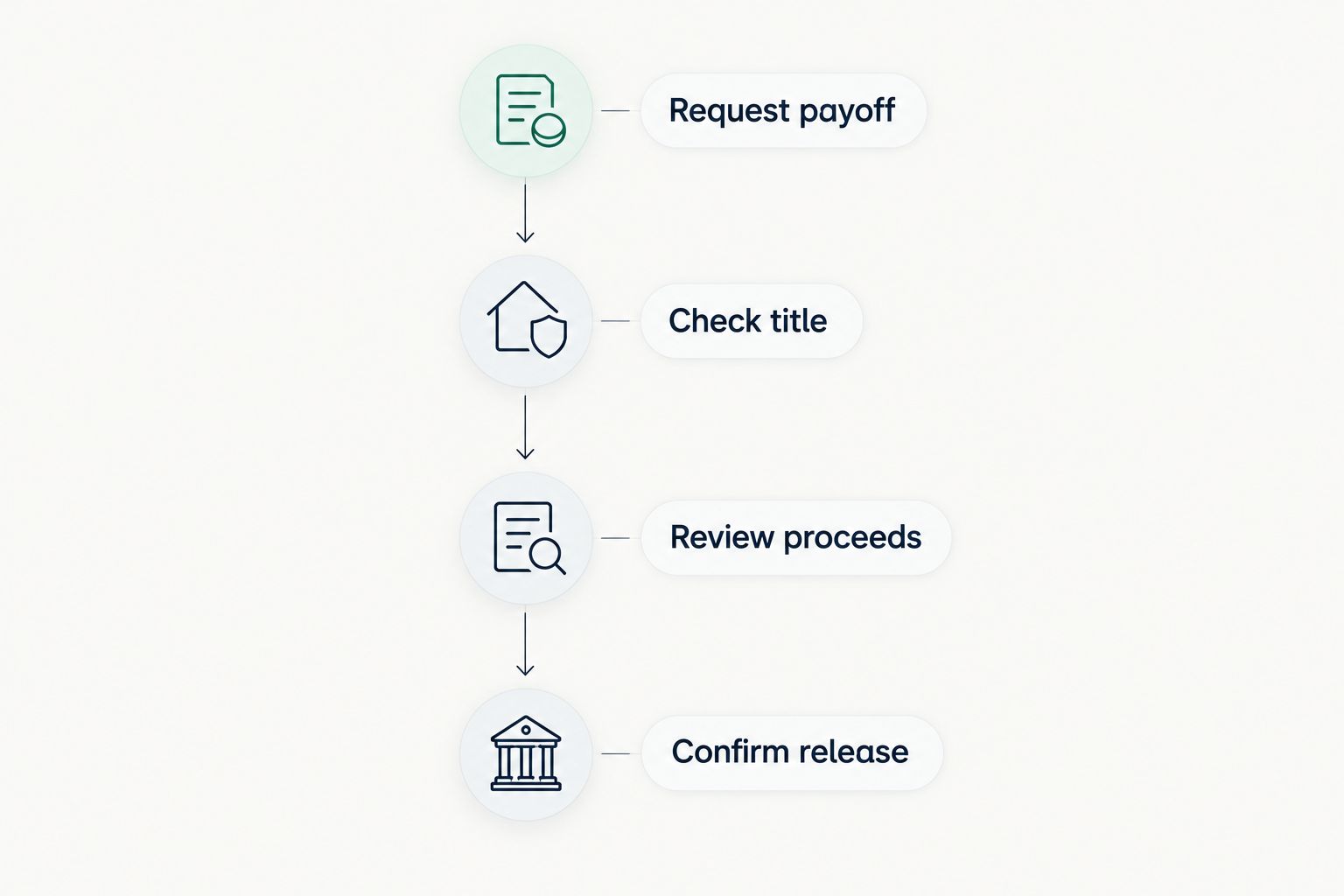
A standard payoff sale follows this sequence. The details depend on your lender, state, and transaction.
Request payoff
Obtain an official payoff statement through the lender or closing professional. Your account balance is not necessarily the payoff amount because interest, fees, or other charges can affect the total.
Check title
The closing professional reviews ownership and recorded claims against the property. Another mortgage, a lien, or an ownership dispute can affect what is needed to complete the sale.
Review proceeds
Review the settlement statement before signing. It should identify the mortgage payoff, transaction charges, and the amount payable to you—or any amount you must bring to closing.
Confirm release
After disbursement, confirm that the payoff was received and that the mortgage lien release or satisfaction is handled. Do not stop scheduled payments solely because a closing is planned; obtain instructions from your servicer and closing professional.
Build a proceeds worksheet before choosing an offer
Use the same worksheet for a listed-sale estimate and a written cash offer. An asking price is not an accepted offer. Label estimates clearly and ask the closing professional to reconcile them before signing.
| Worksheet line | What to record | Where to confirm it |
|---|---|---|
| Proposed purchase amount | The written amount, not an advertised estimate | Buyer offer or signed contract |
| Mortgage payoff | Amount valid for the intended payoff date | Servicer payoff statement |
| Other secured debt | Separate balances for any other loans or liens | Title review and creditor statements |
| Seller transaction charges | Each charge and who agreed to pay it | Contract and settlement estimate |
| Preparation and holding costs | Work and ownership costs you would incur before closing | Written scopes and your records |
| Expected proceeds | Purchase amount less the applicable deductions | Closing professional's itemized estimate |
The Consumer Financial Protection Bureau explains that a mortgage payoff differs from the current balance because it includes interest through the intended payoff date and can include unpaid fees. Confirm the statement date rather than copying the balance from your monthly bill.
Illustrative decision, not a Polus transaction: A listed-sale estimate is higher, but requires repairs and continued ownership costs. A direct offer is lower and avoids that work. Subtract each route's documented costs before deciding; neither the higher headline nor the easier process proves which leaves you with more.
Questions to ask before accepting an offer
Use the same questions for each proposed transaction:
- Is this a cash purchase, a financed purchase, or another arrangement?
- What inspections or approvals remain?
- Who pays each transaction charge?
- Does the expected settlement cover the mortgage payoff and other required amounts?
- What happens if title work reveals another lien?
- What allows either party to cancel or change the agreement?
- What must happen before the proposed closing date is workable?
If the proposal leaves your mortgage in place, ask who remains legally responsible and what happens after a missed payment. Do not describe an arrangement that leaves debt in your name as equivalent to paying it off.
Understand your as-is offer
Requesting an offer does not obligate you to sell. Ask how payoff, costs, and closing conditions apply.
How these options are ranked
The order reflects the decision path: compare a conventional listed sale, consider an as-is purchase, then assess alternatives requiring more seller work or lender approval. The criteria are payoff clarity, net proceeds, preparation, closing conditions, workload, and continuing liability—not an unsupported promise about the highest offer.
Which mortgage sale option should you choose?
Start with a listed-sale estimate if preparation and showings are manageable. Compare a direct as-is offer if they are not. Use the expected settlement result, not just the offer amount, to judge the trade-off.
For your 2026 decision, investigate an assumption only after confirming loan eligibility. Investigate a short sale when proceeds cannot cover payoff and you need lender approval for the shortfall. Neither is a shortcut around the lender.
FAQ
Can I sell my house if I still have a mortgage?
Yes. In a standard sale, the closing professional pays the mortgage lender from the sale proceeds. If the proceeds are insufficient, you must address the shortfall before the transaction can close.
Do I need to pay off my mortgage before listing my home?
No, paying off the mortgage before listing is not normally required. Obtain payoff information early so you can estimate whether the sale will cover the loan and other obligations.
Can a cash buyer buy my house with a mortgage on it?
Yes, a cash buyer can purchase a home with an existing mortgage. The mortgage ordinarily gets paid at closing; a cash offer does not eliminate the debt or guarantee completion.
What happens if I owe more than the sale proceeds cover?
You must resolve the shortfall to complete the sale. Options include bringing funds to closing or seeking lender approval for a short sale, with separate review of any remaining debt.
Can a buyer just take over my mortgage payments?
A private payment arrangement is not the same as a lender-approved assumption or release from liability. Confirm the lender’s requirements and get legal advice before transferring ownership while debt remains in your name.
Does selling my home automatically stop foreclosure?
No. A listing, offer, or pending sale does not automatically stop foreclosure. Contact your servicer and qualified local counsel about deadlines and the steps required in your situation.
Does requesting an offer from Polus Acquisitions Group require me to sell?
No. Requesting a cash-offer review does not obligate you to sell. Any offer remains subject to inspection and transaction requirements, and you can accept or decline.
One last thing
The mortgage statement you receive each month is not your closing payoff statement. Request the official payoff early, then have the closing professional confirm it for the actual closing date.
This is general information, not legal, tax, or financial advice. Get qualified local help for foreclosure deadlines, estate authority, debt liability, or tax questions.


Leave a Reply