
Cash home sales for estate executors are sales without a buyer mortgage contingency, intended to turn estate property into funds while meeting the executor’s responsibilities. This 2026 guide explains how to evaluate offers when ownership authority, beneficiaries, debts, and the home’s condition all affect your decision.
- Cash home sales for estate executors require verified authority, documented value, and a review of the estate’s net proceeds.
- Polus Acquisitions Group suits executors considering an as-is cash sale without preparing an estate home for listing.
- Compare proof of funds, inspection rights, cancellation terms, and closing conditions—not just the offer amount.
- A cash buyer does not remove probate requirements, mortgage payoffs, taxes, or liens.
Why cash home sales matter for estate executors
An executor manages a deceased person’s estate. Probate is the court-supervised process for handling that estate where required; being named in a will does not automatically establish authority to sign a property sale contract.
An estate home brings decisions an ordinary seller might not face. You must distinguish estate belongings from property included in the sale, account for carrying expenses, and explain the transaction to people with an interest in the estate. A vacant home still needs attention while these questions are resolved.
Polus Acquisitions Group is best suited to executors considering an as-is cash sale without preparing an estate home for listing. The trade-off is price: an as-is cash offer can be lower than a successful open-market sale. Polus Acquisitions Group offers a direct-sale option, not a substitute for your legal responsibilities.
For your 2026 decision, separate convenience from value. Avoiding repairs matters, but you still need to understand what the estate receives and what obligations remain.
How to evaluate an estate home cash offer
Use the same written comparison for every buyer. An attractive offer amount tells you little until you know who can sign, what the buyer can cancel over, and which expenses come out at closing.
Confirm your authority before accepting an offer
Start with the estate documents and a qualified local probate attorney. Ask whether your appointment permits the sale, whether court approval is necessary, and whether any notice or consent requirements apply. Requirements depend on the jurisdiction and the estate.
Tell prospective buyers about unresolved authority issues before negotiating a firm closing date. A buyer’s willingness to purchase does not establish your power to sell. Keep the attorney’s instructions in your 2026 estate file so the contract and proposed closing follow the same requirements.
Do not sign as though you personally own the house when you are acting for the estate. Ask how your representative capacity should appear on the agreement.
- Confirm who holds title and who has authority to sign.
- Identify required court approvals, notices, or consents.
- Ask counsel how to sign in your representative capacity.
- Make the proposed closing date conditional on required approvals.
Build your estate file before discussing terms
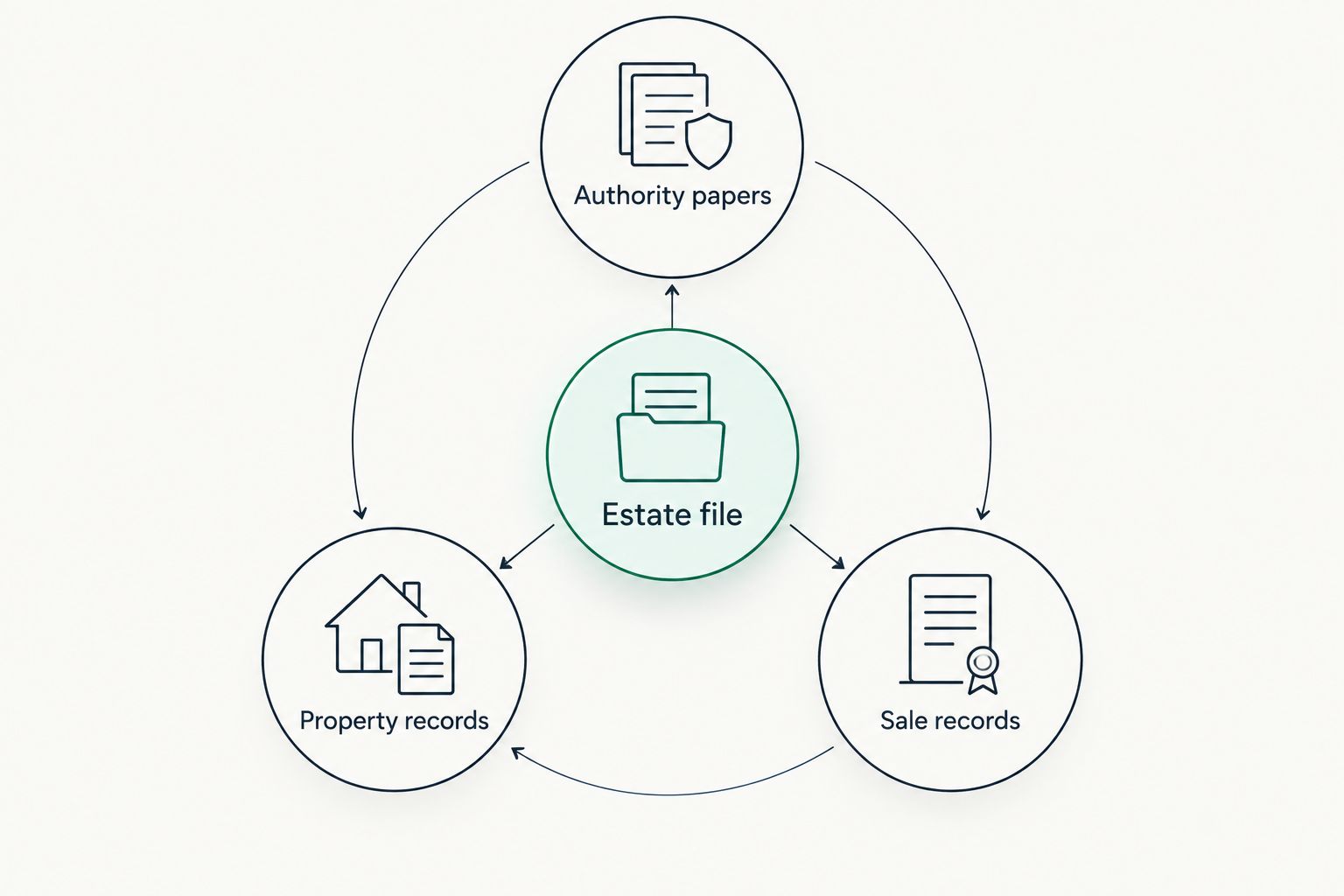
Start with documents already available rather than ordering work immediately. Your estate file should connect the ownership records, the home’s condition, and the reasoning behind the eventual sale. Keep original documents secure and share sensitive information only through an appropriate channel.
Separate known facts from estimates. An old mortgage statement is not a current payoff amount, and an informal repair opinion is not a contractor’s written scope. Mark the source and date of each item so beneficiaries and advisers can understand the comparison later.
Organize the file into 3 document groups. These groups keep the sale decision understandable without requiring an elaborate tracking system.
- Authority papers: Appointment documents, relevant court orders, and counsel’s instructions.
- Property records: Ownership information, insurance, tax notices, mortgage statements, and known condition issues.
- Sale records: Value opinions, written offers, buyer questions, and transaction correspondence.
Establish an as-is value baseline
Begin with a local agent’s assessment of the property in its current condition. Ask which comparable sales support the estimate and whether those homes required similar work. If your attorney recommends an appraisal, ask what valuation date and purpose the appraisal must address.
For a practical comparison, seek 2 written value opinions or estimates when appropriate. This is a suggested decision check, not a universal probate requirement. Do not compare a repaired-home estimate directly with an unrepaired cash offer without accounting for the work, expenses, and uncertainty between them.
Polus Acquisitions Group offers as-is cash sales without requiring repairs, cleaning, or staging. Its first-party seller terms, reviewed November 1, 2026, describe no agent commissions or listing fees and coverage of standard closing costs, subject to the actual written offer. Offers remain subject to inspection and transaction requirements.
- Request an estimate for the home in its present condition.
- Ask which comparable properties support that estimate.
- Separate necessary repairs from optional presentation work.
- Compare written cash terms against the as-is listing alternative.
Verify the buyer and the source of funds
Ask for the purchasing party’s legal name and evidence that the buyer can fund the proposed purchase. Have the closing professional or your attorney review that information. A cash label alone is not proof that the buyer can perform.
Read the agreement for financing conditions, assignment rights, and the identity of the party actually responsible for closing. Assignment means the buyer can transfer contractual rights to another purchaser; ask whether that is permitted and what happens if a replacement purchaser is not found.
If a proposal leaves an existing mortgage in place or pays the estate over time, it is not the same as receiving cash at closing. Obtain independent advice about payment, default, and continuing loan risks.
- Match the buyer’s name across the offer and funding evidence.
- Ask whether the purchase depends on outside financing.
- Review any right to assign the contract.
- Identify when the estate receives the purchase funds.
Compare net proceeds instead of headline amounts
Create 1 comparison sheet using the same categories for every offer. Start with the purchase amount, then identify transaction expenses and obligations payable from the proceeds. Ask the closing professional for a preliminary settlement estimate rather than guessing the final amount.
An offer with fewer preparation requirements can still produce lower net proceeds. Conversely, a larger listing estimate is not a completed sale. Include supported repair estimates, property expenses during the expected marketing period, and any agreed selling costs without treating uncertain figures as facts.
Standard closing-cost coverage does not erase a mortgage, taxes, liens, or other estate obligations. Have each proposed deduction explained, and update the comparison when a payoff statement or contract term changes.
- Separate the purchase amount from estimated net proceeds.
- List mortgage payoff, taxes, liens, and agreed transaction expenses separately.
- Include documented preparation and carrying expenses where relevant.
- Label every estimate and record its source.
Read the inspection and cancellation terms
Read the entire purchase agreement before signing. An as-is sale generally concerns the property’s condition; it does not automatically remove inspection rights or legally required disclosures. Ask your attorney how to answer condition questions when you did not live in the home.
The inspection clause deserves particular attention. Identify what the buyer can inspect, the deadline for doing so, and whether the buyer can cancel or request a change afterward. An initial offer is not a guaranteed closing amount when the agreement permits further negotiation.
Also check who holds the earnest-money deposit, if one is required, and the conditions for returning it. Earnest money is a contract deposit, not proof that the entire purchase is funded.
- Mark inspection deadlines and permitted cancellation reasons.
- Ask how any requested price change must be documented.
- Review deposit handling and refund conditions.
- Confirm required disclosures with qualified local counsel.
Plan the handover around actual closing requirements
Build the handover plan around title work, estate authority, required approvals, and the written agreement. A requested closing date is a target until the transaction requirements are satisfied. Do not promise beneficiaries a distribution date based only on a buyer’s preferred schedule.
Address belongings separately from the building. Selling without cleaning or staging does not answer who keeps family photographs, documents, valuables, or items specifically left to beneficiaries. Obtain advice before disposing of estate property, and record what must be removed or can remain.
Confirm who maintains insurance, utilities, and access until ownership transfers. If tenants occupy the property, obtain local advice about leases and notice requirements rather than assuming a sale ends their occupancy.
- Put possession and belongings arrangements in writing.
- Confirm access arrangements and responsibility for property care.
- Coordinate title and approval requirements with the closing professional.
- Keep closing proceeds separate from personal funds and follow estate-account instructions.
Understand your estate home offer
Discuss an as-is offer and the estate’s requirements. Requesting an offer does not obligate you to sell.
Compare estate home sale options in 2026
Choose the route that fits the estate’s priorities and requirements. The strongest decision is supported by evidence, not by the shortest promised timeline. A local professional can help you compare alternatives without assuming every property needs renovation.
| Option | Best for | Main advantage | Key limitation |
|---|---|---|---|
| Polus Acquisitions Group as-is cash sale | Executors who want to avoid preparing the home for listing | No repairs, cleaning, or staging required; review the written cost terms | The offer can be below a successful open-market result and remains subject to inspection and transaction requirements |
| Another direct cash buyer | Executors seeking another written purchase proposal | Gives you additional terms to compare | Funding, cancellation rights, costs, and buyer obligations require separate verification |
| Agent-assisted as-is listing | Executors seeking market exposure without committing to repairs | Tests buyer interest in the home’s current condition | Showings, inspections, negotiation, and an uncertain marketing period remain |
| Prepare the home, then list | Estates able to manage work before seeking buyers | Allows condition issues to be addressed before marketing | Requires spending, oversight, and time without guaranteeing a better net result |
For each route, ask the same question: what evidence supports the expected net result? Do not treat a cash proposal as automatically inadequate or a listing estimate as money the estate will certainly receive.
Common mistakes estate executors make
Treating beneficiary agreement as signing authority
Family agreement does not establish legal authority to sell. Confirm the appointment, title, and applicable approval requirements before committing the estate. Keep communications factual rather than promising a particular outcome.
Spending on repairs before comparing alternatives
Repairs create decisions about scope, payment, and supervision. Obtain appropriate authorization and compare the expected benefit with an as-is sale before committing estate funds. Do not assume every buyer requires a cleared or renovated house.
Confusing as-is with no disclosures
An executor’s limited knowledge does not justify guessing or hiding known issues. Ask counsel which disclosures apply and how to explain information that remains unknown. Preserve relevant inspection reports and correspondence.
Choosing a date before checking the contract
A short proposed timeline has little value if authority, title, or funding remains unresolved. Review the conditions behind the date and arrange property care in case closing changes. Never assume a sale alone resolves a foreclosure deadline.
FAQ
Can an executor sell an estate house for cash?
An executor can sell an estate house for cash when the executor has the required authority and follows applicable estate and sale requirements. A cash buyer does not remove court approvals, notices, or title requirements that apply to the estate.
Do all beneficiaries have to agree to a cash sale?
Beneficiary consent requirements depend on the governing documents, court orders, and applicable law. Ask a qualified local probate attorney what approvals or notices your particular sale requires.
Is a cash offer better than listing an estate home?
A cash offer is not automatically better than listing an estate home. Compare supported net proceeds, preparation work, carrying expenses, contract conditions, and the estate’s ability to manage the process.
Can an executor sell without cleaning out the house?
An executor can negotiate a sale that allows agreed belongings to remain, but the agreement must say what stays. Protect estate documents, valuables, and items owed to beneficiaries before agreeing to disposal or removal.
What costs remain when a buyer covers standard closing costs?
Mortgage payoff, taxes, liens, and other estate obligations can remain even when a buyer covers standard closing costs. Review the purchase agreement and settlement estimate to identify which amounts the estate must pay.
Does Polus Acquisitions Group require repairs before a sale?
Polus Acquisitions Group describes an as-is purchase process without required repairs, cleaning, or staging. Offers remain subject to inspection and transaction requirements, and requesting an offer does not obligate the executor to sell.
How quickly can an estate cash sale close?
An estate cash sale can close only after the applicable ownership, title, approval, funding, and contract requirements are satisfied. Ask the closing professional and estate attorney for a transaction-specific schedule rather than relying on a general speed claim.
One last thing
A buyer’s bank balance and an executor’s authority answer different questions. Funding shows whether the buyer can pay; authority establishes whether you can commit the estate. Neither replaces the other.
Before accepting an offer in 2026, ask your attorney to review the actual agreement—not just an offer summary. This guide provides general information, not legal, tax, or financial advice. Keep the written reasoning behind your choice alongside the signed documents.


Leave a Reply