
.pseo-content { font-size: 17px; line-height: 1.7; color: inherit; }
.pseo-content h2 { font-size: 1.6em; margin-top: 1.8em; margin-bottom: 0.6em; line-height: 1.3; color: inherit; }
.pseo-content h3 { font-size: 1.25em; margin-top: 1.5em; margin-bottom: 0.4em; line-height: 1.35; color: inherit; }
.pseo-content h4 { color: inherit; }
.pseo-content p { margin: 0 0 1em; }
.pseo-content ul, .pseo-content ol { margin: 0 0 1em 1.4em; padding: 0; }
.pseo-content li { margin: 0.3em 0; }
.pseo-content strong { font-weight: 600; }
.pseo-content blockquote { margin: 1.2em 0; padding: 0.6em 1em; border-left: 3px solid color-mix(in srgb, currentColor 30%, transparent); background: color-mix(in srgb, currentColor 4%, transparent); color: inherit; }
.pseo-content a { text-decoration: underline; }
.pseo-content .pseo-table-wrap { overflow-x: auto; margin: 1.4em 0; -webkit-overflow-scrolling: touch; }
.pseo-content table { width: 100% !important; border-collapse: collapse !important; table-layout: auto !important; font-size: 0.96em; }
.pseo-content table th,
.pseo-content table td {
padding: 10px 12px !important;
border-bottom: 1px solid color-mix(in srgb, currentColor 14%, transparent) !important;
border-left: none !important;
border-right: none !important;
vertical-align: top !important;
text-align: left !important;
word-break: break-word !important;
overflow-wrap: anywhere !important;
white-space: normal !important;
}
.pseo-content table th {
background: color-mix(in srgb, currentColor 6%, transparent) !important;
color: inherit !important;
font-weight: 600 !important;
border-top: 1px solid color-mix(in srgb, currentColor 14%, transparent) !important;
}
.pseo-content table tr:last-child td { border-bottom: 1px solid color-mix(in srgb, currentColor 14%, transparent) !important; }
You generally do not need a real estate agent to sell your house for cash in 2026; you can sell directly to a buyer and arrange the closing support your state and transaction require. But skipping an agent does not remove your disclosure duties, existing contractual obligations, or the need to resolve ownership, mortgage payoff, and title issues before closing.
- Do I need a real estate agent to sell my house for cash? Generally, no; closing requirements still apply.
- An agent handles pricing, marketing, and negotiation; a closing provider handles different work.
- Polus Acquisitions Group offers an as-is cash-offer review without requiring an agent listing.
- Compare your expected net proceeds, contract terms, and remaining responsibilities before choosing a route.
Do I need an agent for a cash sale, or just closing support?
You need the right help for the work, not necessarily an agent. If you already have a buyer, your remaining needs include a purchase contract, required disclosures, title review, payoff information, and a properly handled transfer. Our guide to selling a house without a real estate agent explains the broader decision.
These are different selling routes, not substitutes for closing requirements:
| Selling route | Best for | Main advantage | Main trade-off |
|---|---|---|---|
| Agent-assisted cash sale | Owners who want representation and help finding or comparing buyers | An agent can handle marketing, negotiation, and transaction coordination | Agent compensation and listing obligations depend on your agreement |
| Direct cash sale with closing support | Owners who have a buyer and prefer to manage the selling decision themselves | You can avoid preparing an agent listing and communicate directly with the buyer | You remain responsible for evaluating the offer and arranging advice where needed |
A direct sale can involve an attorney, a title company, an escrow provider, or a combination, depending on local practice and state requirements. Ask who handles each task before signing.
Why this matters
A cash buyer changes the financing arrangement, not the legal work. Cash generally means the purchase does not depend on the buyer obtaining a purchase mortgage. It does not mean ownership transfers without documents or that the buyer has waived inspections.
The useful question in 2026 is not simply whether you can avoid an agent. It is whether you have someone qualified to handle the work you do not understand or do not want to manage.
An agent can help you assess competing offers. A closing provider can process a transaction. An attorney can advise you about legal obligations. Those roles overlap in some tasks, but they are not interchangeable.
What an agent does that closing support does not
An agent can help you choose an asking strategy, market the home, arrange showings, communicate with buyers, and negotiate terms. That support matters when you want broader market exposure or do not already have a suitable buyer.
An agent can also coordinate deadlines and paperwork within the scope of the representation agreement. An agent does not replace legal advice about disputed ownership, inheritance rights, or contract liability.
The trade-off is the representation agreement itself. Read its compensation terms, cancellation provisions, and any obligations that continue after it ends. If you already signed a listing agreement, do not assume that finding a cash buyer independently eliminates what you owe.
A direct sale removes the need to create a listing. It also leaves you without a listing agent's assistance unless you separately arrange representation.
What closing support actually covers
Closing support handles the steps needed to complete the transfer under the contract. The exact division of responsibility depends on your state, the providers involved, and their written engagement.
Before choosing a provider for your 2026 sale, ask what the service includes and whose interests the provider represents.
Title review and ownership
Title review examines ownership records and identifies recorded matters that need attention. These can include mortgages, liens, judgments, or ownership questions.
Title work is not the same as deciding whether your offer is financially attractive. A title provider also does not automatically become your personal legal adviser.
Funds, payoffs, and documents
The closing process includes coordinating funds, obtaining payoff information, preparing or collecting required documents, and arranging recording of the transfer. Who performs each task varies by location.
Ask for a written settlement statement showing how the transaction funds are allocated. Your gross offer is not your take-home amount. Mortgage payoff, taxes, liens, and agreed expenses can affect what you receive.
Legal advice and contract review
A real estate attorney can explain your contract, advise you about legal risk, and help address ownership or authority questions. Confirm whether the attorney represents you, the buyer, a lender, or another participant.
The benefit is advice directed to your legal situation. The limitation is scope: a contract-review engagement does not necessarily include marketing, valuation, litigation, or every closing task.
Why the support you need varies
Your need for help depends more on the transaction than on the word cash. Review these factors before deciding that closing support alone is enough:
- Existing agreements. A listing agreement or another signed contract can create obligations even if you find the buyer yourself.
- Ownership authority. Multiple owners, an estate, a trust, or a divorce-related dispute can affect who must approve and sign.
- Mortgage and title issues. Payoffs, recorded liens, unpaid taxes, or title defects can require work before funds are distributed.
- Property disclosures. Selling as-is does not automatically remove disclosure obligations imposed by law.
- Contract conditions. Inspection rights, cancellation rights, deposits, assignment terms, and deadlines determine what each party can do.
- State requirements. Attorney involvement, document preparation, escrow handling, and closing practices differ by state.
If you cannot explain a clause that affects your money or obligations, get qualified help before accepting it. A buyer's explanation is not independent advice.
How to prepare for a direct cash sale
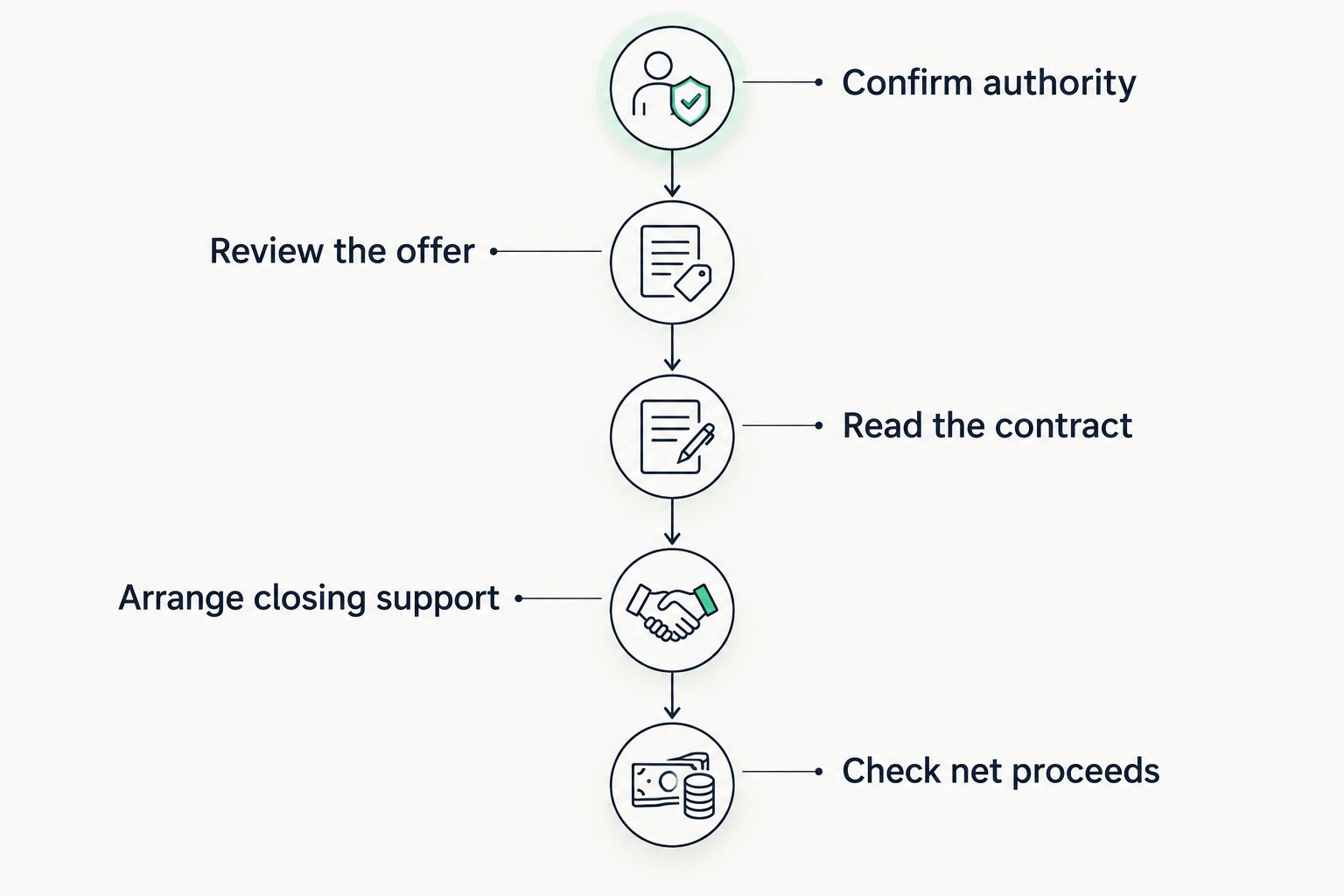
Use this sequence to separate the selling decision from the closing work. For a sale you are considering in 2026, request current documents and current payoff information rather than relying on an old estimate.
- Confirm authority. Establish who owns the home and who has authority to sign. For an inherited property, probate—the court process for administering an estate—can affect that authority.
- Review the offer. Confirm the buyer's identity, how the purchase will be funded, and what conditions apply. Request appropriate evidence of funds rather than treating the word cash as proof.
- Read the contract. Check inspection rights, deposits, deadlines, cancellation provisions, and whether the buyer can assign the contract to someone else. Ask what happens if either side fails to perform.
- Arrange closing support. Confirm the closing provider, any required attorney involvement, and who represents you. Verify payment instructions through an independently confirmed contact method before sending money or sensitive information.
- Check net proceeds. Review the settlement statement, mortgage payoff, taxes, liens, and allocated expenses. Confirm the possession date and what must happen before keys change hands.
Do not treat a proposed closing date as a guarantee. Title problems, ownership questions, court requirements, lender requirements, and unresolved contract conditions can affect completion.
Ask for changes in writing. A verbal promise about repairs, possession, or expenses should not replace terms you can read in the agreement.
When is an agent worth considering for a cash sale?
An agent is worth considering when you want help reaching buyers and negotiating, even if you prefer a cash offer. Cash buyers can purchase listed homes; an agent-assisted sale does not have to mean accepting a financed offer.
Broader exposure lets you seek competing offers, but it does not guarantee a particular result. Marketing, showings, buyer access, and the representation agreement still need to fit your circumstances.
If your priority is testing the open market, ask an agent how the home would be marketed in its current condition. Do not assume you must renovate before discussing a listing.
Is closing support enough if I already have a cash buyer?
Closing support can be enough when you have an agreed transaction and no unresolved need for representation or legal advice. But you still need to understand the contract, satisfy required disclosures, and confirm that the buyer can perform.
Choose additional help based on the problem. A disputed inheritance calls for legal advice; uncertainty about market exposure calls for a different conversation than document signing.
For foreclosure concerns, get qualified local legal help promptly. A proposed sale does not guarantee that foreclosure activity pauses or that a closing will occur before a lender's deadline.
Does selling as-is remove the need for inspections or disclosures?
Selling as-is does not automatically eliminate inspections or legally required disclosures. It describes the condition in which you are offering the home and the repairs you are not agreeing to make, subject to the contract.
Read the inspection language carefully. A buyer's right to inspect is different from a buyer's right to cancel, request changes, or renegotiate after inspecting.
If you know about a material property problem, ask a qualified local professional how your state's disclosure rules apply. Do not rely on the phrase as-is to answer that question.
Where a direct as-is offer fits
Polus Acquisitions Group is a fit for homeowners who want an as-is cash-offer review without preparing an agent listing. You can compare that route with an agent-assisted sale and decide whether the convenience fits your priorities.
At Polus Acquisitions Group, we offer a free, no-obligation cash-offer review. You do not need to repair, clean, or stage the home to request an offer, and requesting one does not obligate you to sell.
Our stated terms include no agent commissions or listing fees and coverage of standard closing costs, subject to the actual written offer. That does not erase mortgage balances, taxes, liens, or other seller obligations. Offers remain subject to inspection and transaction requirements.
The trade-off deserves equal attention: an as-is cash offer can be lower than a successful open-market sale. Compare expected net proceeds, preparation work, contract conditions, and the closing timeline—not just the convenience of avoiding a listing.
If alternative purchase terms are proposed, ask exactly how payment and ownership will work. An arrangement involving future payments or an existing loan is not the same as a cash purchase and requires its own review.
Understand your as-is selling option
Request a free cash-offer review. You choose whether to accept or decline.
FAQ
Do I need a real estate agent to sell my house for cash?
You generally do not need a real estate agent to sell your house for cash. You still need to meet state requirements, honor existing agreements, provide required disclosures, and arrange a properly handled closing.
Can a title company replace my real estate agent?
A title company does not replace every service a real estate agent provides. Title and closing work do not automatically include pricing advice, marketing, negotiation, or legal representation.
Do I need a lawyer if the buyer is paying cash?
Attorney requirements depend on your state and the work involved. Independent legal advice is especially relevant when the contract is unclear or ownership, probate, divorce, or foreclosure issues affect the sale.
Can I sell directly if I already signed a listing agreement?
Your listing agreement determines your obligations when you sell directly. Review compensation, exclusivity, cancellation, and any continuing obligations before signing a separate sale contract.
Does a cash buyer pay off my mortgage?
An existing mortgage generally must be addressed as part of transferring clear title. In a conventional sale, payoff is handled through closing from the transaction funds; it is not debt forgiveness.
Does Polus Acquisitions Group require me to accept an offer?
Polus Acquisitions Group does not require you to accept an offer after requesting its free cash-offer review. Offers remain subject to inspection and transaction requirements, and you retain the choice to accept or decline.
One last thing
For your 2026 sale, ask this before signing: Who is advising me, and who is only processing the transaction? The person coordinating documents is not automatically your representative.
Then ask for the written terms and a clear explanation of your expected proceeds. This article provides general information, not legal, tax, or financial advice; get qualified local advice for your specific situation.
Related guides
{“@context”:”https://schema.org”,”@type”:”FAQPage”,”mainEntity”:[{“@type”:”Question”,”name”:”Do I need a real estate agent to sell my house for cash?”,”acceptedAnswer”:{“@type”:”Answer”,”text”:”You generally do not need a real estate agent to sell your house for cash. You still need to meet state requirements, honor existing agreements, provide required disclosures, and arrange a properly handled closing.”}},{“@type”:”Question”,”name”:”Can a title company replace my real estate agent?”,”acceptedAnswer”:{“@type”:”Answer”,”text”:”A title company does not replace every service a real estate agent provides. Title and closing work do not automatically include pricing advice, marketing, negotiation, or legal representation.”}},{“@type”:”Question”,”name”:”Do I need a lawyer if the buyer is paying cash?”,”acceptedAnswer”:{“@type”:”Answer”,”text”:”Attorney requirements depend on your state and the work involved. Independent legal advice is especially relevant when the contract is unclear or ownership, probate, divorce, or foreclosure issues affect the sale.”}},{“@type”:”Question”,”name”:”Can I sell directly if I already signed a listing agreement?”,”acceptedAnswer”:{“@type”:”Answer”,”text”:”Your listing agreement determines your obligations when you sell directly. Review compensation, exclusivity, cancellation, and any continuing obligations before signing a separate sale contract.”}},{“@type”:”Question”,”name”:”Does a cash buyer pay off my mortgage?”,”acceptedAnswer”:{“@type”:”Answer”,”text”:”An existing mortgage generally must be addressed as part of transferring clear title. In a conventional sale, payoff is handled through closing from the transaction funds; it is not debt forgiveness.”}},{“@type”:”Question”,”name”:”Does Polus Acquisitions Group require me to accept an offer?”,”acceptedAnswer”:{“@type”:”Answer”,”text”:”Polus Acquisitions Group does not require you to accept an offer after requesting its free cash-offer review. Offers remain subject to inspection and transaction requirements, and you retain the choice to accept or decline.”}}]}


Leave a Reply