
Cash home buyers get your address from public property records, purchased marketing lists, information you submitted online, or referrals; phone numbers and email addresses can come from separate records matched to your name or property. In 2026, receiving an offer does not prove that you requested contact, that the sender knows your circumstances, or that the sender has inspected your home.
- How do cash home buyers get my address? Public property records often connect an owner with a mailing address.
- A property address does not explain how a buyer obtained your phone number or email address.
- Ask the sender to identify the business, explain the data source, and stop unwanted marketing.
- The Federal Trade Commission’s Do Not Call protections address covered sales calls, not mailed purchase offers.
Why this matters
Knowing your address is not the same as knowing your home’s condition or having your permission to contact you. An unsolicited letter can look personal while relying on information available to anyone searching ownership records.
You do not need to confirm personal details, discuss your mortgage, or explain why you might sell. If selling is something you are considering, compare the outreach with your own goals first. This guide to selling a house as-is for cash explains the sale choice separately from the marketing that brought it to your attention.
How do cash home buyers get my address and contact details?
The main distinction is between property information and contact information. A county record can identify an owner and mailing address without supplying a current mobile number or email address.
A marketer can combine sources. The resulting contact record does not necessarily show where each individual detail originated.
| Information source | What it can supply | What it does not establish |
|---|---|---|
| County assessor or property-tax records | Owner name, property address, and tax mailing address | Permission to call or text |
| Recorded deeds | Ownership and recorded transfers | Current phone number or intention to sell |
| Public court filings | Information in publicly accessible estate or foreclosure proceedings | A complete picture of your circumstances |
| Purchased marketing lists | Compiled names, addresses, and other contact fields | That every detail is accurate or current |
| Online forms | Details you entered when requesting information | Permission beyond the request and applicable consent terms |
| Referrals | Information another person supplied | That you personally authorized marketing |
For a particular message, the sender must explain its own source. These are routes through which information becomes available, not proof of how any named company obtained yours.
Public property records connect an owner to an address
County property records commonly connect a property with its recorded owner and a mailing address used for tax notices. That mailing address can differ from the home’s street address, especially for rentals or inherited property.
A buyer can use that information to send a purchase letter without ever speaking to you. Public access and search methods vary by jurisdiction, and not every document or personal detail is publicly accessible.
Purchased lists can add phone numbers and email addresses
Data brokers compile information from multiple sources and sell access to contact records. A property owner’s name and address can be matched against those records to find additional contact details.
Some marketers call this matching process skip tracing. The term does not establish accuracy: an old number, shared household information, or an incorrect match can lead to contact with the wrong person.
Forms and referrals create a different trail
If you requested an offer online, the business receiving that request has the details you submitted. Whether another business also receives them depends on the form’s disclosures, privacy terms, and actual handling of the request.
A referral creates another possible source. Ask who referred you rather than accepting a vague statement that you previously expressed interest.
Why the contact details buyers use vary
The information attached to your property depends on the records being used and how those records are combined. These factors help explain why a letter reaches the correct house while a call reaches the wrong person:
- Mailing address: Your property-tax mailing address can be different from the property address.
- Ownership changes: A recorded transfer and a purchased list do not necessarily reflect changes at the same time.
- Shared names: Matching by name alone can connect information belonging to someone else.
- Public filings: Accessible estate or foreclosure records contain different information from ordinary ownership records.
- Your submissions: Details entered in an offer request differ from information found in county records.
Treat each contact field separately. Correct ownership information does not validate a phone number, and an accurate phone number does not establish consent to every form of marketing.
Does an unsolicited offer mean someone knows I need to sell?
No. An unsolicited offer does not establish that the sender knows you need to sell. A message can be based on ownership information rather than a conversation about your plans.
Public filings sometimes reveal an estate proceeding or foreclosure action, but they do not explain your entire situation. A sender’s reference to an inherited home, repairs, or a deadline is not a reason to disclose additional financial information.
You retain the choice to ignore the message, ask questions, or consider a sale. For an actual foreclosure deadline, contact your mortgage servicer and qualified local legal help rather than relying on a buyer’s marketing language.
Is it legal for cash home buyers to contact me in 2026?
Access to a public record does not make every subsequent call, text, or email lawful. The rules depend on the communication method, the message, consent, and applicable federal and state law.
A letter offering to buy your property is different from a covered telemarketing call selling you something. Do not assume that every home-purchase solicitation falls under the same federal restrictions. State laws can also impose separate requirements.
For covered sales calls, Federal Trade Commission guidance states that registration on the National Do Not Call Registry can take up to 31 days to stop calls from companies covered by its rules. The FTC also requires covered telemarketers to access the registry at least every 31 days; neither rule makes the registry a universal block on all unwanted contact.
The Federal Communications Commission provides guidance on unwanted calls, texts, and caller-ID spoofing. Use current agency guidance when assessing a specific message, especially if it involves automated contact. This is general information, not legal advice about an individual caller.
How can I find out where a buyer got my information?
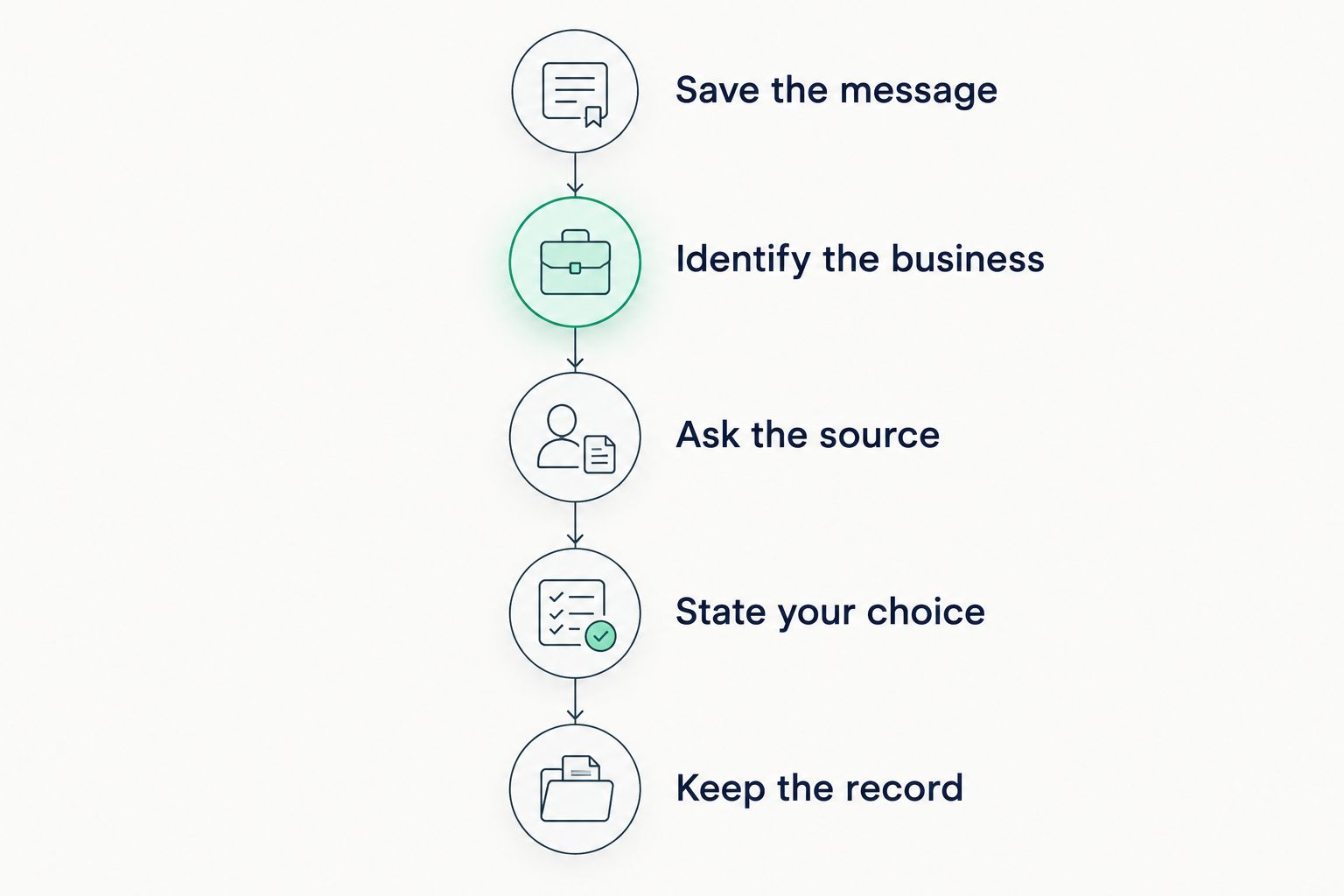
You can ask for an explanation without confirming the information the sender already has. In 2026, use the same basic process whether the first contact arrives by mail, phone, text, or email.
- Save the message. Keep the letter and envelope, or capture the text, email, voicemail, and displayed contact information. Record when it arrived.
- Identify the business. Ask for the business’s legal name and a written explanation of whom the sender represents. Verify identity independently before sharing sensitive details.
- Ask the source. Ask where the business obtained your mailing address, phone number, and email address. Request an answer for each field rather than a general reference to public records.
- State your choice. If you do not want contact, clearly request that marketing stop. Keep a copy of your request.
- Keep the record. Preserve later messages so you can document continued contact or make an appropriate complaint.
A clear source explanation is useful, but it is not independent proof that the company is trustworthy. Check the proposed transaction separately: who signs the contract, who purchases the home, and what conditions allow the agreement to change or end.
How do I stop unwanted home-buyer calls, texts, and mail?
Start with a clear request to stop marketing, then use the controls appropriate to the communication channel. No single request removes your information from every public record, purchased list, or business database.
| Contact method | Practical next step | Limitation |
|---|---|---|
| Mailed letters | Ask an identifiable sender to remove you from its mailing list | This does not erase county ownership records |
| Calls | Request no further calls, block unwanted numbers, and review reporting options | Caller-ID information can be spoofed |
| Text messages | Use your device’s reporting tools; use opt-out instructions only for a sender you recognize | Interacting with an unknown sender can create additional risk |
| Use unsubscribe controls for a recognized business; mark suspicious messages as spam | Avoid links or attachments from an unverified sender |
Privacy rights also vary by state and by the business involved. A deletion or opt-out request can have exceptions, including records a business must retain. Ask what the business can remove and what it will keep rather than assuming that suppression and deletion mean the same thing.
If the message includes threats, impersonation, or requests for sensitive information, preserve it and report it through the appropriate consumer-protection or law-enforcement channel. Do not send identification documents merely to satisfy an unsolicited caller.
What if I actually want to sell as-is?
Separate the marketing question from the sale decision. You can dislike an unsolicited call and still decide to explore selling; you can also request information and decline every offer.
Polus Acquisitions Group is a fit for homeowners who want an as-is cash-offer review without preparing a home for listing. We offer a free, no-obligation review, and requesting it does not commit you to selling.
For a Polus Acquisitions Group cash home-buying offer, our stated terms include no agent commissions or listing fees, no repairs, cleaning, or staging, and coverage of standard closing costs, subject to the written offer. Mortgage payoff, taxes, liens, and other seller obligations do not disappear. Offers remain subject to inspection and transaction requirements.
The trade-off matters: an as-is cash offer can be lower than the proceeds from a successful open-market sale. Compare the written offer, expected deductions, repair responsibilities, and closing conditions—not just the headline amount. If an alternative payment arrangement is proposed, require its terms and risks in writing; it is not a cash purchase.
For your 2026 sale decision, choose the route that fits your priorities rather than the company that contacts you most often. We can discuss a closing timeline, but title, ownership authority, lender requirements, and applicable court requirements affect whether and when a transaction closes.
Choose whether to request an offer
Discuss an as-is sale without committing to accept an offer.
FAQ
How did a cash home buyer get my address if I never contacted them?
A cash home buyer can obtain your address from public property records or a purchased marketing list without a prior conversation. Ask the sender which source supplied your particular address.
Does knowing my address mean a home buyer has my permission to text me?
No. Knowing your address does not establish permission to text you. Rules depend on the message, technology, consent, and applicable law.
Can I remove my address from public property records?
You generally cannot erase ordinary ownership records simply because you do not want marketing. Access restrictions and address-confidentiality protections depend on your jurisdiction and eligibility.
Will the Do Not Call Registry stop every cash home buyer?
No. The National Do Not Call Registry does not cover every type of communication or every property-purchase solicitation. FTC guidance allows up to 31 days for registration to stop covered sales calls.
Does a cash offer letter mean the buyer inspected my home?
No. A cash offer letter alone does not establish that the buyer inspected your home. Ask what information supports the amount and which inspection or transaction conditions apply.
Can I ask Polus Acquisitions Group about an as-is sale without agreeing to sell?
Yes. Polus Acquisitions Group offers a free, no-obligation cash-offer review for homeowners considering an as-is sale. You choose whether to accept or decline, and offers remain subject to inspection and transaction requirements.
One last thing
An envelope addressed to you proves that someone has a mailing record—not that the sender understands your home, your finances, or your plans. Before responding to a home-buying message in 2026, ask where the contact details came from and what the sender is actually proposing.
You do not owe an unsolicited buyer an explanation for keeping your home. If you want to sell, start with your priorities and compare written terms.


Leave a Reply